Lakefly: Monitoring Ullswater’s Ecology
Local volunteers are building a long-term picture of Ullswater’s freshwater ecology, one shoreline sample at a time.
Friends of the Ullswater Way coordinates regular monitoring at six shoreline sites using the Freshwater Biological Association’s Lakefly method. Volunteers collect and identify freshwater invertebrates and record what they find, building a local dataset that can be compared over time.
Lakefly is continuing under the Freshwater Biological Association, although new training and expansion are currently on hold while further funding is sought. Existing groups, including FOUW’s Ullswater volunteers, have been asked to continue surveying and building the longer dataset needed to develop the method.
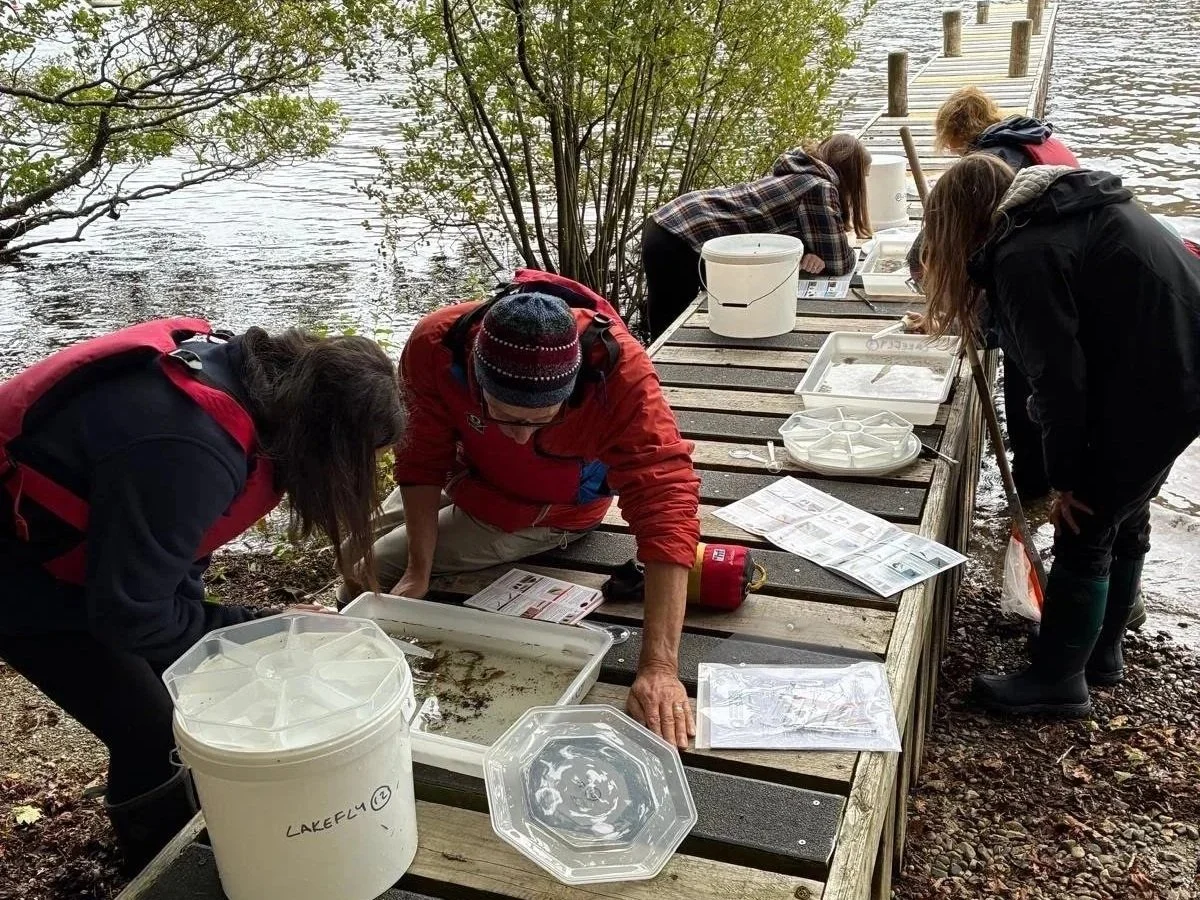
Lakefly volunteers sort and identify freshwater invertebrates collected from the Ullswater shoreline. Repeating the same survey regularly helps build a picture of how the lake changes through the seasons and over time.
Why look beneath the surface?
Ullswater may appear unchanged from the shore, but the life within it responds to water temperature, nutrients, weather, pollution and the changing seasons.
Freshwater invertebrates — including mayfly larvae, caddisflies, snails, beetles, worms and leeches — form an important part of the lake’s food web. Because different groups tolerate different environmental conditions, shifts in the community can provide useful early evidence of ecological change.
A public survey carried out in 2025 found strong interest in the project. Seventy-eight per cent of respondents expressed concerns about the ecology of the lake, with water quality, algal blooms and sewage among the main issues raised. Ninety-nine per cent supported establishing the project.
This monitoring gives local people a practical way to learn more about Ullswater while contributing information that becomes more useful with every repeated survey.
From lakeshore sample to long-term record
Lakefly is a pilot citizen-science method developed by the Freshwater Biological Association. It has been adapted from Riverfly, an established approach used by volunteer groups to monitor rivers, but further scientific work is still needed to understand fully what Lakefly scores reveal about the health of different lakes. At each site, trained volunteers follow the same Lakefly procedure:
Volunteers use a net to sample a defined stretch of shallow shoreline habitat.
The sample is placed in trays so that small animals can be separated from leaves, stones and vegetation.
Using the Lakefly identification guide, volunteers look for 24 groups of freshwater invertebrates.
The presence or absence of each group is recorded and used to calculate a Lakefly score.
Once the invertebrates have been identified and recorded, they and the remaining sample material are carefully returned to the lake at the sampling site.
Returning to the same site each month builds a record of seasonal and longer-term change.
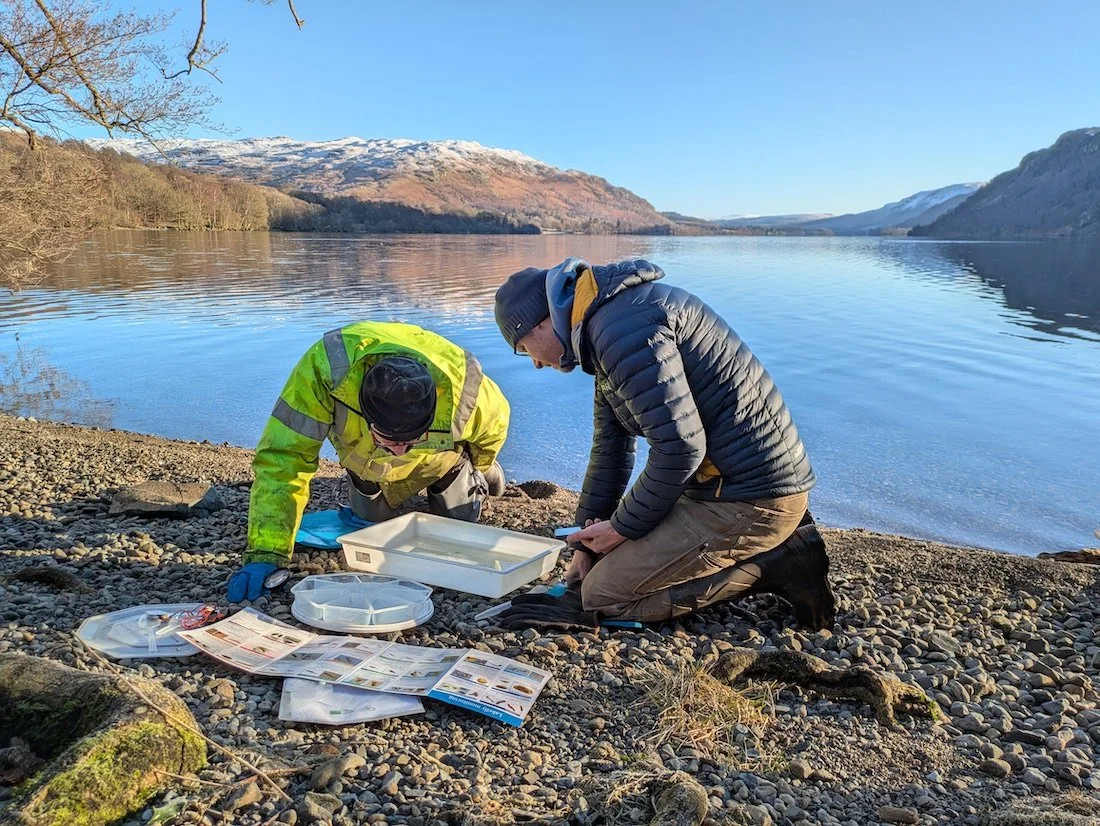
Volunteers use a standard identification guide to record the freshwater-invertebrate groups found in each sample.
The method uses broad invertebrate groups rather than detailed species-level identification. Individual records are not currently independently checked, although periodic group identification sessions could help volunteers compare uncertain specimens.
What does a Lakefly score mean?
A Lakefly score is not a simple pass or fail for water quality.
The score reflects the mix of freshwater-invertebrate groups recorded during a survey. On its own, a higher number does not necessarily mean “better” water, and a lower number does not necessarily mean that something is wrong.
Lakes differ naturally. Ullswater is a relatively low-nutrient lake, and those conditions may support fewer invertebrates than a warmer, more nutrient-rich lake with abundant aquatic vegetation. A more nutrient-rich lake elsewhere might therefore produce a higher score even where some aspects of water quality are poorer.
The important comparison is with previous results from the same site.
The Freshwater Biological Association is still developing guidance on how Lakefly scores should be interpreted in relation to lake health. Until that work is complete, the scores should be treated as developing evidence rather than a direct measure of water quality.
With enough consistent surveys, and suitable specialist review, the records may begin to show the normal range of variation at each Ullswater site. A sudden fall, a sustained decline or a shift from sensitive groups such as mayflies towards more pollution-tolerant groups such as worms and midges could then indicate a change worth investigating. Any such pattern would need to be considered alongside the limitations of the sampling and discussed with an appropriate specialist body.
The results recorded so far are contributing to the longer dataset needed to establish the normal range at Ullswater’s monitoring sites and understand what departures from that range might mean. The results are helping build an early local record of what is found at Ullswater’s monitoring sites.
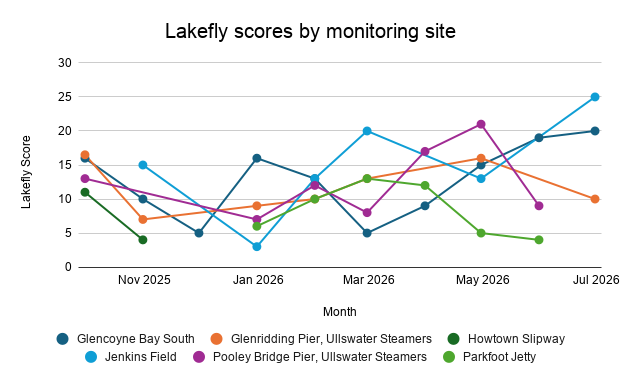
Early Lakefly results from six established monitoring sites. Scores are most useful when compared with earlier results from the same site; gaps show visits for which no sample was recorded.
Building a long-term local record
The first surveys have recorded a varied freshwater-invertebrate community around Ullswater’s shoreline. Volunteers have found groups including caddisflies, mayflies, alderflies, beetles, snails, freshwater shrimp, worms and midges.
Results vary between sites and visits. Some of that variation may reflect genuine differences in the invertebrate community, while some may arise from sampling conditions or differences between surveyors.
Continued monitoring at the six active sites will help show which patterns recur over time. FOUW is also exploring how group identification checks and specialist advice could strengthen the consistency and interpretation of the results.
Monitoring water used for recreation
Lakefly monitoring is complemented by laboratory testing at three popular lakeshore locations used for swimming and paddlesports. Samples from Glenridding, Glencoyne Bay and Park Foot are tested for E. coli, coliform bacteria and intestinal enterococci.
Samples are collected carefully and sent promptly for laboratory analysis. The results provide a snapshot of conditions at a particular place and time, rather than a guarantee of water quality across the whole lake.
The testing is funded through the Freshwater Community Grant.
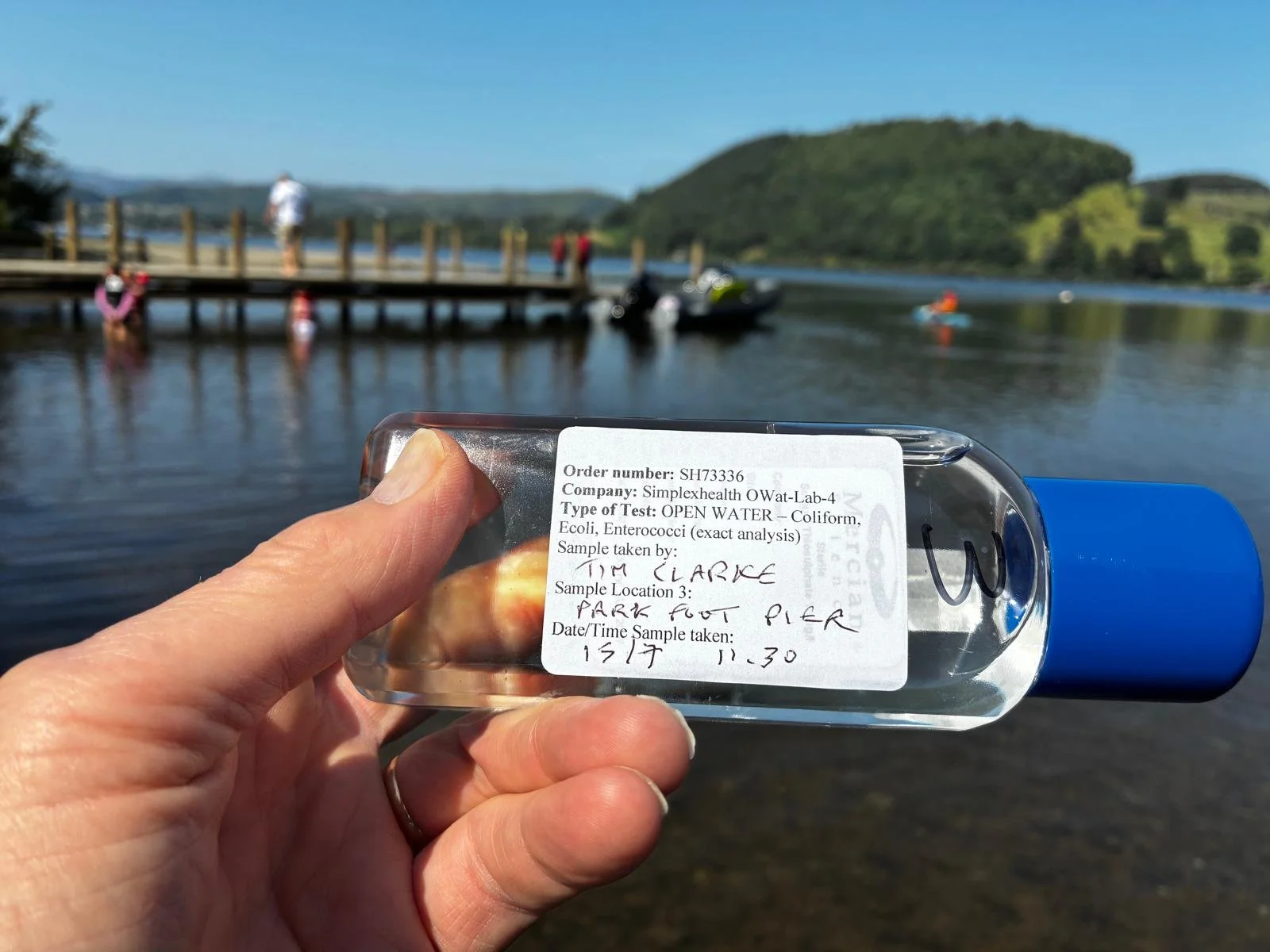
Water samples from three Ullswater locations are sent to SimplexHealth for laboratory analysis of E. coli, coliform bacteria and intestinal enterococci.
Community monitoring with specialist input
Friends of the Ullswater Way established the local monitoring network and continues to coordinate volunteers, equipment and the six active shoreline sites.
The Freshwater Biological Association developed the Lakefly method, provided the initial training and continues to oversee the existing volunteer network. Survey records are now being moved to Cartographer, the database already used by Riverfly volunteers, giving groups secure access to their records and creating a stronger national dataset for future analysis.
The FBA is seeking funding to expand the network and complete the scientific work needed to interpret Lakefly scores more fully. In the meantime, FOUW’s volunteers will continue regular monitoring around Ullswater and submit their results through the new system. Our role includes:
coordinating the six monitoring sites;
recruiting, equipping and supporting volunteers;
working with landowners and partner organisations;
helping collect, organise and share the results;
funding complementary bacteriological testing and linking the work with local schools.
The project complements — rather than replaces — monitoring and investigation by professional bodies such as the Environment Agency and UK Centre for Ecology & Hydrology.
Strengthening the next phase
Volunteers will continue regular Lakefly monitoring at the six active sites, extending the local record across seasons and years. The next stages are to:
Maintain regular sampling at the active shoreline sites, building a longer record across seasons and years.
Keep the Ullswater results, site information and sampling records together in an accessible and usable form.
Seek specialist advice on the range of results that may be expected at each site and what could represent a meaningful change.
Support secondary-school students to learn the method and contribute their own observations.
Publish clear updates while distinguishing between what the results show, what remains uncertain and what may need further investigation.
Partners and project support
This project brings together community coordination, specialist knowledge, access to sampling sites, funding and local volunteer time.
Project lead and coordination
Friends of the Ullswater Way established the local monitoring programme, coordinates the sampling sites, supports volunteers, provides equipment and helps organise and share the results.
Friends of the Ullswater Way
Lake District National Park Authority
Dalemain
Ullswater Steamers
Outward Bound Trust
Patterdale Hall
UK Centre for Ecology & Hydrology
Eden Rivers Trust
Ullswater Catchment Management CIC
Ullswater Association
FOUW is now exploring which organisations may be able to provide appropriate specialist support for the next phase of the monitoring.
Powered by volunteers
Explore further
Watch: Freshwater ecology and the Lakefly project
Dr Louise Lavictoire of the Freshwater Biological Association explains the science behind freshwater monitoring.
Explore Ullswater’s freshwater ecology
Find out more about Ullswater and its ecology in this article on the Heritage Knowledge Bank.

Ullswater Ecology Education Project
Discover how local secondary-school students are learning through fieldwork on the lake.
